Ad Monetization (Mobile Apps): Definition, Strategy, and How to Maximize It
Ad monetization is the process of generating revenue from a mobile app by displaying ads to users, including rewarded video, interstitials, banners, and native ads.
Formula:
Ad Revenue = Impressions × eCPM / 1,000
What is Ad Monetization?
Ad monetization is the process of earning revenue from your mobile app by showing advertisements to your users. Also referred to as in-app advertising (IAA), it is one of the most widely used monetization strategies in mobile, particularly for free-to-play games and apps that want to keep the core experience free while still generating income.
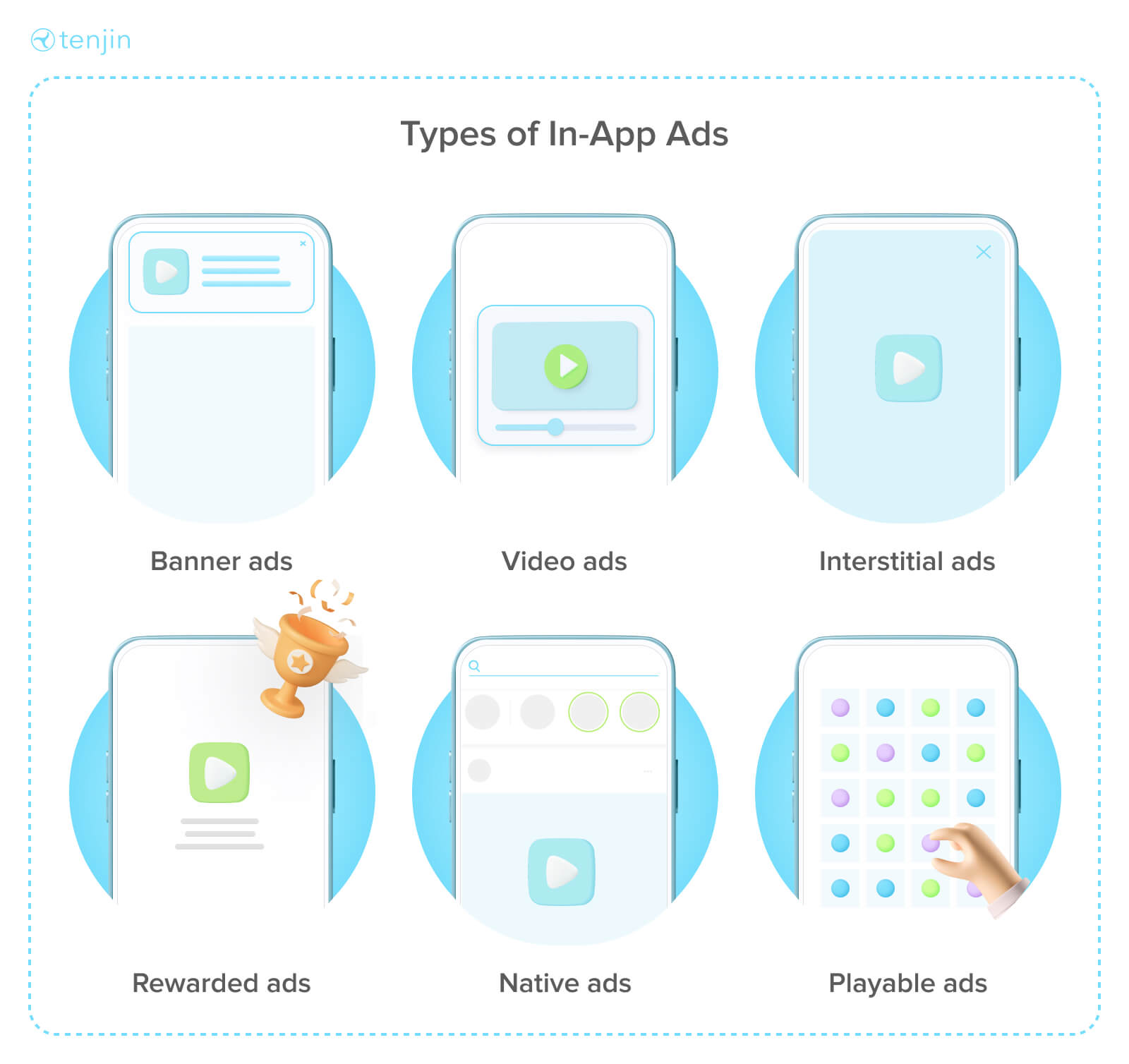
Common ad formats include:
- Rewarded video ads: users watch an ad in exchange for in-app rewards
- Interstitial ads: fullscreen ads shown at natural transition points
- Banner ads: static or animated ads displayed within the app interface
- Native ads: ads that blend into the app's content and design
- Playable ads: interactive ad units that let users preview another app
Ad Monetization Formula
Ad Revenue = Impressions × eCPM / 1,000
Where:
- Impressions = the number of times an ad is shown
- eCPM = effective cost per mille (revenue earned per 1,000 impressions)
Example: 500,000 impressions at an $8.00 eCPM = $4,000 in ad revenue
Why Ad Monetization Matters
Ad monetization turns your entire user base into a revenue stream, not just paying users.
- Generate revenue from nonpaying users
- Supplement IAP and subscription revenue
- Scale earnings as your user base grows
- Optimize ROAS with full revenue visibility
- Detect and defend against fraudulent ad requests
Example: A casual game with 100,000 DAU and a 2% paying user rate still earns ad revenue from the other 98% of users.
How Do You Monetize A Mobile App?
There are two main ways that users can monetize their mobile apps: through in-app purchases (IAP), and through in-app advertisements (IAA).
Ad Monetization by Ad Format
Not all ad formats perform equally. Choosing the right format for your app and audience is one of the most important decisions in your ad monetization strategy. Here is a breakdown of the most common formats, how they work, and when to use them.
Rewarded Ads
Rewarded ads are opt-in ads where users choose to watch a short video in exchange for an in-app reward, such as extra lives, virtual currency, or premium content. They consistently deliver the highest eCPMs of any format and have the lowest negative impact on user experience because the interaction is voluntary.
- Best for: games and apps with a virtual economy
- Average eCPM: $10–$30 in Tier 1 markets
- When to use: when users need a boost or have run out of a resource
Interstitial Ads
levels or after completing a task. They generate strong eCPMs but need to be used carefully. Showing them too frequently or at the wrong moment leads to user frustration and drop off.
- Best for: games and apps with clear session breaks
- Average eCPM: $4–$12 in Tier 1 markets
- When to use: at natural pauses, never midaction
Banner Ads
Banner ads are small static or animated ads displayed at the top or bottom of the screen. They are the easiest format to implement and run continuously in the background, but they generate the lowest eCPMs and users often develop banner blindness over time.
- Best for: apps with long session times
- Average eCPM: $0.50–$2.00 in Tier 1 markets
- When to use: as a passive, always-on revenue layer alongside other formats
Native Ads
Native ads are designed to match the look and feel of your app's interface. Because they blend into the content, they tend to feel less intrusive and can generate strong engagement rates when implemented well.
- Best for: content apps, news apps, and social platforms
- Average eCPM: $3–$10 in Tier 1 markets
- When to use: when user experience is a priority and you want ads to feel seamless
Playable Ads
Playable ads are interactive ad units that let users try a mini version of another app before downloading it. They are primarily used as a UA format but can also appear within your app as a monetization tool through ad networks.
- Best for: gaming apps
- Average eCPM: $8–$20 in Tier 1 markets
- When to use: when your audience is highly engaged and receptive to trying new apps
Pro tip: Most successful apps use a combination of formats. Rewarded video for high value moments, interstitials at transition points, and banners as a passive background layer. Testing different combinations is the fastest way to find what works for your audience.
How to Measure Ad Monetization
To measure ad monetization accurately, you need a mobile analytics tool or mobile measurement partner (MMP) like Tenjin, that aggregates ad revenue alongside other monetization sources. This lets you attribute ad revenue to specific campaigns, break down performance by cohort or country, and spot discrepancies that may signal fraud or integration issues.
How does Tenjin Support Ad Monetization?
Tenjin provides users with a dedicated Ad Monetization Report that consolidates and normalizes revenue data, and ties it back to their ad campaign spend. The ad revenue is cohorted to life-time value (LTV) and tied to return on investment (ROI).
The dashboard allows users to view their ad monetization data from different ad networks (or ad monetization channels) and get access to the following metrics for each of their apps:
- Reported Ad Revenue
- Reported Impressions
- Reported Clicks
- eCPM (Effective Cost per Mille)
- eCPC (Effective Cost per Click)
How to Find Ad Monetization Data in Tenjin
In Tenjin, ad revenue has its own dedicated section in the dashboard. Switching between your IAP and ad revenue data takes just seconds using a simple tab, so everything you need is always within reach.
Furthermore, Tenjin measures IAA or ad revenue in two ways:
- Through the Channel API: pulling ad revenue data directly from your ad networks
- Through Mediators: capturing revenue data from your mediation platforms
Both are handled automatically, giving you a complete and accurate view of your ad monetization performance without any manual work.
This dual-source approach does more than reconcile numbers. It protects your profitability and supports smarter growth decisions:
- Complete revenue visibility: capture revenue from every monetization channel in your stack
- Smarter ROAS optimization: mediation data provides impression-level detail and near real-time callbacks for fast UA decisions
- Improved revenue completeness: the channels API captures networks outside your mediation stack and serves as a reliable benchmarking metric
- Fraud detection: large discrepancies between sources can indicate fraud, integration issues, or gaps in network connections, giving you a framework to investigate rather than guess
Want to see this in action? Watch our team explain why our customers love how we calculate revenue for in-app purchases.
https://www.youtube.com/watch?v=hy8ksi6R__k
How to Increase Ad Monetization Revenue
- Use rewarded ads for higher eCPMs and better user experience
- Optimize ad placement and frequency to avoid user dropoff
- Use ad mediation to work with multiple networks and maximize fill rates
- Monitor eCPM by country and format to prioritize high value inventor
- Adopt a hybrid monetization model combining IAA and IAP to capture value from every use
Common Ad Monetization Mistakes
Even experienced mobile marketers make ad monetization mistakes that quietly drain revenue or damage user experience. Here are the most common ones and how to avoid them.
1. Overloading Users With Ads
Showing too many ads too frequently is one of the fastest ways to lose users. High ad frequency leads to frustration, negative reviews, and uninstalls. Always prioritize user experience over short term impression volume. A user who stays in your app for months is worth far more than a user who leaves after a single session.
2. Using Only One Ad Network
Relying on a single ad network limits your fill rate and caps your eCPM potential. If that network has low demand for your inventory, you leave revenue on the table. Using ad mediation to work with multiple networks simultaneously ensures every impression goes to the highest bidder.
3. Ignoring Ad Placement and Timing
Where and when you show ads matters as much as which formats you use. Ads that interrupt users mid-action or appear at the wrong moment create a poor experience. Test placement and timing carefully and use data to identify the moments that drive engagement without causing dropoff.
4. Not Tracking Ad Revenue Accurately
Many developers track installs and IAP revenue closely but treat ad revenue as an afterthought. Without accurate ad revenue tracking, you cannot calculate true ROAS, compare campaign performance fairly, or make informed UA decisions. Using a tool that aggregates both IAP and ad revenue in one place removes this blind spot.
5. Ignoring Discrepancies Between Revenue Sources
Discrepancies between your mediation platform and your channels API data are normal to a degree. But large or growing discrepancies are a signal worth investigating. They can indicate fraud, misconfigured integrations, or missing network connections. Ignoring them means potentially losing revenue without knowing why.
6. Neglecting Tier 2 and Tier 3 Markets
While Tier 1 markets like the US and UK generate the highest eCPMs, Tier 2 and Tier 3 markets can still contribute meaningfully to total ad revenue, especially at scale. Optimizing ad networks and formats for lower tier markets ensures you are not leaving impression volume unrewarded.
7. Treating Ad Monetization as Separate From UA
Ad revenue should be part of your UA decisionmaking, not siloed from it. If a campaign drives users who generate high ad revenue over time, that value needs to be factored into your ROAS calculations. Treating ad monetization and UA as separate functions leads to undervaluing campaigns that are actually performing well.
Ad Monetization and ARPDAU
ARPDAU = (IAP Revenue + Ad Revenue) / Daily Active Users
If your ad monetization improves, your ARPDAU goes up even if your user count stays the same. It is one of the clearest signals that your monetization strategy is working.
Key Takeaways
Ad monetization is one of the most powerful and scalable revenue strategies available to mobile app developers. When done well, it generates income from your entire user base, not just the small percentage who make direct purchases.
Here is what to remember:
- Ad monetization turns nonpaying users into revenue. Even if only 2–3% of your users make purchases, 100% of them can see ads.
- The formula is simple. Volume and quality both matter.
Ad Revenue = Impressions × eCPM / 1,000
- Format choice matters. Rewarded video consistently delivers the highest eCPMs and the best user experience. Use a mix of formats to maximize revenue across different user moments.
- Dual-source tracking is essential. Measuring ad revenue through both your mediation platform and your channels API gives you complete visibility, supports accurate ROAS calculations, and provides a framework for detecting fraud.
- Discrepancies are actionable. Small differences between revenue sources are normal. Large ones are a signal to investigate.
- Hybrid monetization maximizes total revenue. Combining IAA with IAP captures value from every user, paying or not.
- UA and ad monetization are connected. Factor ad revenue into your campaign performance metrics to get a true picture of ROAS and LTV.
With the right tools and strategy in place, ad monetization becomes more than a revenue stream: you can use it to your advantage.
Related Terms
Mobile Measurement Partner (MMP)
Frequently Asked Questions
What is ad monetization?
Ad monetization is the process of generating revenue from a mobile app by displaying advertisements to users. It includes formats like rewarded video, interstitials, banners, and native ads, and is also referred to as in-app advertising (IAA).
How do you monetize an app with ads?
Integrate one or more ad networks into your app, choose your ad formats, and configure placements. Revenue is earned each time a user views or interacts with an ad. Using ad mediation and working with multiple networks helps maximize fill rates and eCPM.
What is the difference between ad monetization and in-app purchases?
Ad monetization earns revenue by showing ads to users, while in-app purchases earn revenue when users buy virtual goods or content directly. Many apps use both together in a hybrid monetization model to generate revenue from all users, paying and nonpaying alike.
Can you monetize an app without ads?
Yes. Apps can generate revenue through in-app purchases, subscriptions, or paid downloads. However, ad monetization is one of the most effective ways to generate income from free users who would not otherwise pay.
What is ad monetization attribution and why does it matter?
Ad monetization attribution connects your ad revenue back to the campaigns that acquired those users. It gives you a complete picture of campaign value, helps you calculate accurate ROAS, and supports better UA budget decisions.
How can you increase ad monetization revenue?
Use high-performing formats like rewarded video, optimize ad placement and frequency, work with multiple networks through mediation, and adopt a hybrid monetization model combining ads with in-app purchases.
What is a good eCPM for mobile ad monetization?
eCPM varies by format, geography, and user quality. Rewarded video typically commands the highest eCPMs in Tier 1 markets. Tracking eCPM by format and country helps you identify your highest value inventory.
What is dual-source ad revenue tracking?
Dual-source ad revenue tracking means measuring ad revenue through both your ad mediation platform and your channels API. This gives you complete revenue visibility, improves benchmarking, and provides a framework for detecting discrepancies that may indicate fraud or integration issues.