Definition:
A mobile measurement partner (MMP) is a third-party platform that collects attribution data and measures how well mobile marketing campaigns perform across advertising channels. MMPs give advertisers a unified, accurate view of where their users come from and how they behave after install.
Formula:
Attribution Accuracy = Installs Attributed to Correct Source / Total Installs × 100
What is a Mobile Measurement Partner (MMP)?
A mobile measurement partner (MMP) is a tool that collects attribution data and assesses how well a campaign is doing across various advertising channels.
When a user sees an ad, clicks on it, and installs your app, an MMP is what connects those dots. It tells you which network served the ad, which campaign drove the click, and whether that user went on to make a purchase, complete onboarding, or churn within the first week. Without an MMP, this chain of events is invisible.
In simple terms, an MMP answers the most important question in mobile marketing: where are my best users coming from?
Every ad network reports its own performance data. Without a neutral third party to reconcile those numbers, marketers are left with fragmented, often conflicting data from sources that each have an incentive to report favorably. An MMP sits above all of that and provides a single source of truth.
Example: A mobile game runs ads across five networks, but each network overcounts installs. An MMP eliminates the overlap and shows which network actually drove each install.
How Does a MMP Work?
A crucial role performed by MMPs is accurately and impartially attributing app installs to specific ad networks. To understand how this works, it helps to know who the key parties are:
- Advertiser: owns the app featured in the ad
- MMP: collects attribution data and measures campaign performance across channels
- Publisher: provides the ad space inside their app
- Ad Network: acts as the intermediary between publisher and advertiser, matching ad supply to demand
- User: the person being targeted with the advertiser's ads
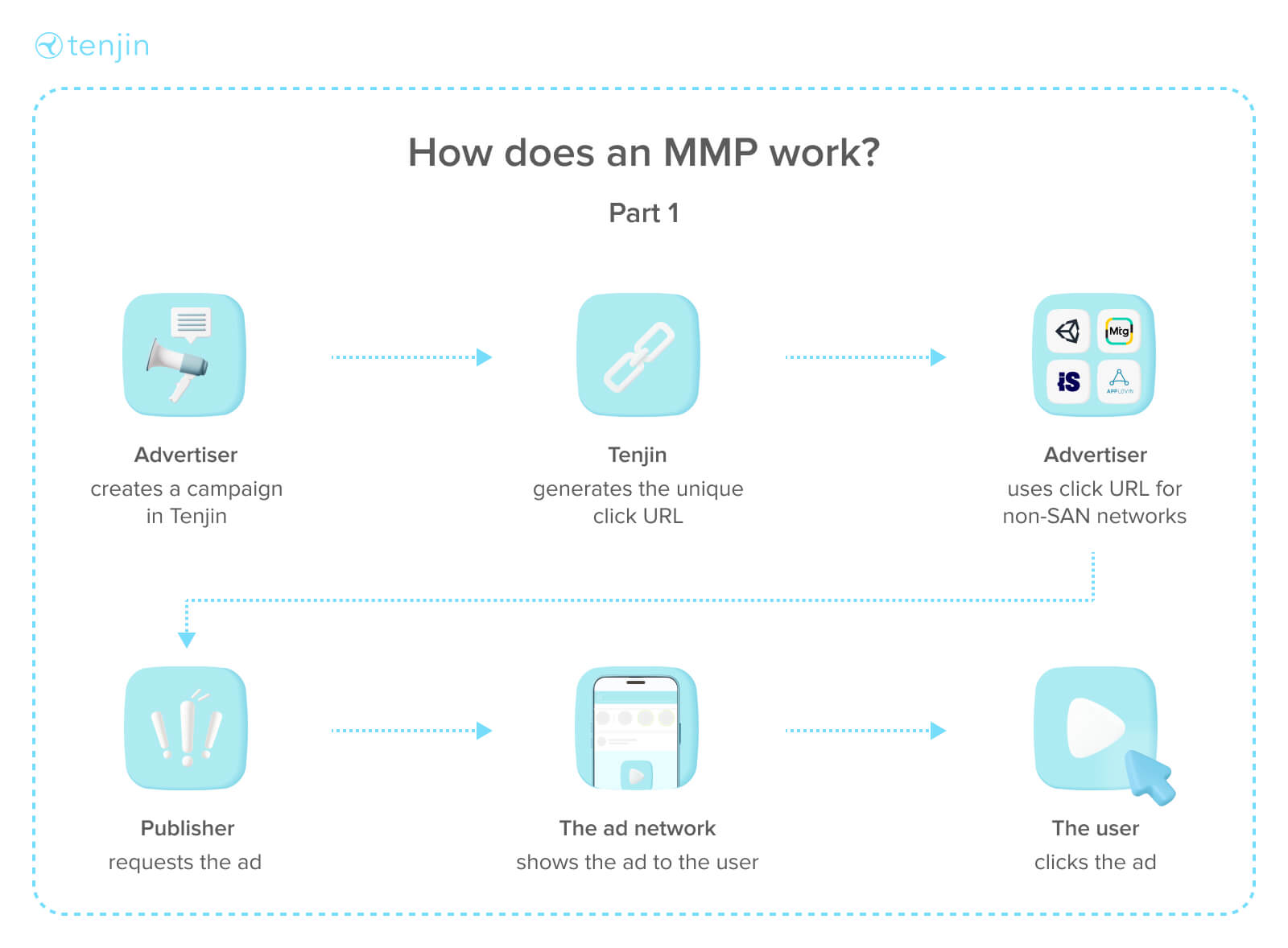
Here is how the process works. We've separated it into two parts, the steps that take place before and after a user clicks on an ad.
Before the user clicks:
- The advertiser creates a campaign in their MMP
- The MMP generates unique click URLs or deep links for each channel
- The publisher app requests an ad from the ad network
- The ad network serves the ad inside the publisher app
After the user clicks:
- The user clicks the ad and the MMP server is notified
- The user is redirected to the app store
- If the user installs the app, the MMP server is notified again
- The MMP attributes the install to the correct ad network and notifies that network of the conversion
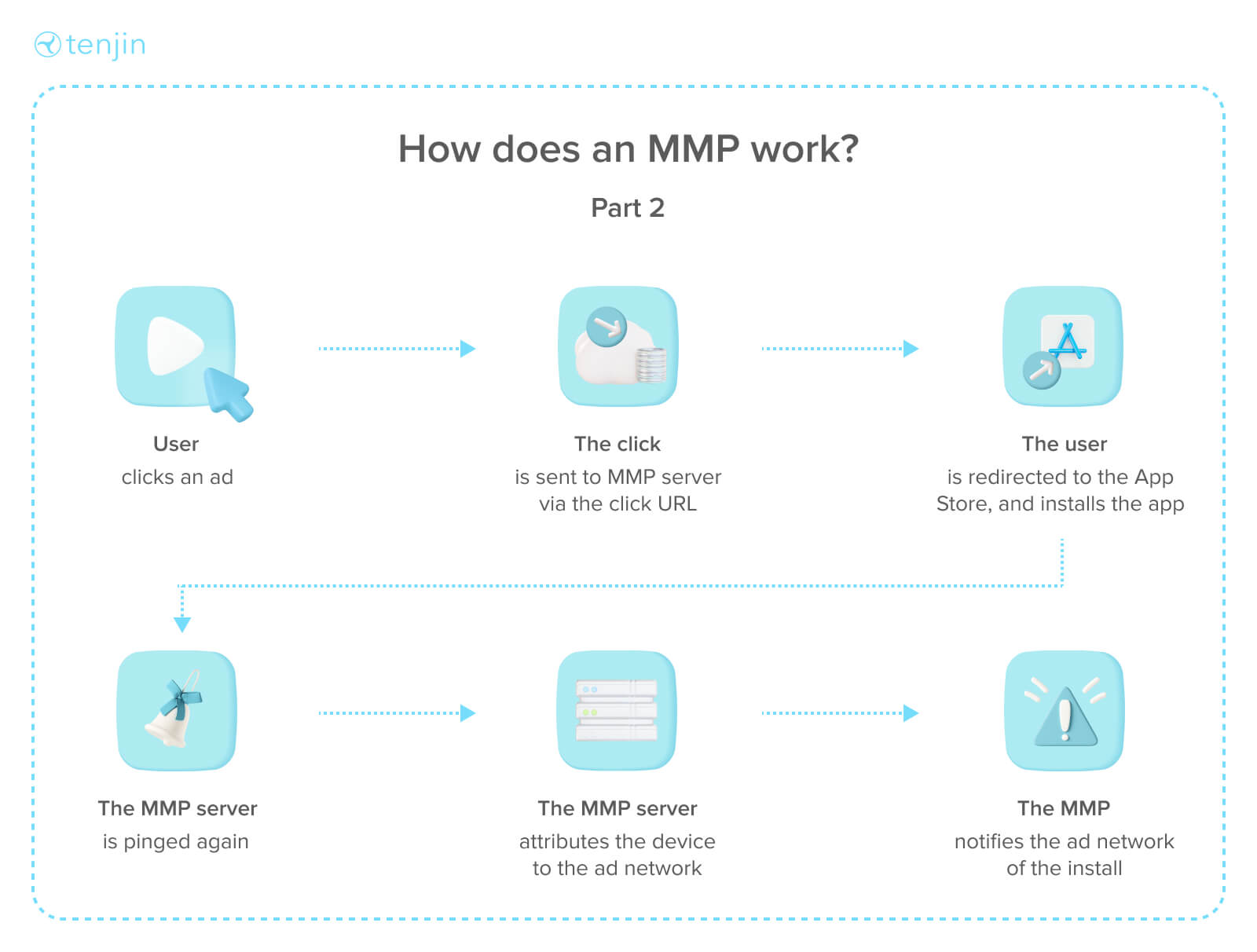
This process happens in real time across every install your app receives.
Example: A user clicks on a Mintegral ad for a puzzle game but does not install it. Later, they see a Google Ads campaign for the same game and install it. According to the last-click attribution model, the install is attributed to Google Ads. All subsequent in-app events such as purchases, ad clicks, level completions are tied to that Google Ads campaign. The advertiser pays Google Ads for the install, not Mintegral.
This matters because before attribution existed, advertisers would pay every network a user interacted with.
An MMP ensures you only pay the network that actually delivered the install.
What Does a Mobile Measurement Partner Measure?
An MMP measures far more than installs. A full-featured mobile app measurement partner tracks the entire user journey from first ad impression to long-term in-app behavior.
Key measurement areas include:
- Install attribution: which campaign, network, creative, and channel drove each install
- In-app events: purchases, registrations, tutorial completions, and any custom events you define
- Revenue attribution: connecting IAP and ad revenue back to the acquisition source
- Retention and churn: how long users from each source stay active
- Cohort performance: comparing the lifetime behavior of users acquired at different times or from different sources
- Fraud detection: identifying and filtering invalid installs and click spam
- ROAS measurement: understanding the revenue return on every dollar of ad spend
Why You Need a Mobile Measurement Partner
Any advertiser aiming to grow their marketing efforts needs an MMP. As your user acquisition campaigns scale and you start incorporating more channels, trying to analyze data across multiple ad network dashboards becomes impractical.
Each ad network calculates metrics differently. Without a tool to normalize that data, comparisons are unreliable and decisions are based on incomplete information.
Some advertisers try to minimize complexity by limiting campaigns to one or two networks and relying on those networks' own dashboards. The problem with this approach is straightforward: if one of those channels underperforms, there is no fallback and no reliable data to guide the next move. Consistently experimenting with different channels is a stronger strategy, and an MMP is what makes that possible at scale.
Here are some benefits of having an MMP in your tech stack:
- Ad networks self-report. Every network has an incentive to claim credit for installs. An MMP provides neutral, third-party attribution that no single network controls.
- Cross-channel campaigns are complex. Users see ads across multiple platforms before installing. An MMP tracks the full journey and applies consistent attribution logic across all channels.
- In-app events matter as much as installs. An install that never monetizes is worth nothing. MMPs connect acquisition data to downstream revenue and behavior.
- Fraud is unfortunately a reality. Click injection, device farms, and SDK spoofing inflate install numbers without delivering real users. MMPs detect and filter fraudulent activity before it distorts your data.
- One SDK replaces many. Instead of integrating a separate SDK for every ad network you work with, you integrate one MMP SDK. It handles communication with every connected network from a single integration point.
- Privacy changes have made measurement harder. ATT, SKAdNetwork, and evolving privacy frameworks have fragmented mobile measurement. MMPs navigate these constraints and help marketers maintain accuracy in a privacy-first environment.
In general, MMPs empower advertisers to get a unified view of their marketing data. Using an MMP ensures that you can access and analyze all your marketing data in one normlized and unified view. This also helps to identify the top performing or lowest performing channels and campaigns so you can adapt, optimize, and focus on those with the highest conversion rates. It shows you the road to better ROI.
Example: A casual game pauses a campaign because network-reported CPI looks high. Their MMP data tells a different story: that campaign is driving users with 3x the average Day 30 retention and significantly higher LTV. Without the MMP connecting acquisition cost to post-install behavior, the team would have cut one of their best-performing campaigns based on surface-level data.
A MMP Is Necessary for UA Meta & Facebook
Facebook (Meta) is one of the most important channels in mobile user acquisition, and MMP integration with Facebook is a core use case for most mobile marketers. This is because Facebook does not share raw click-level data directly with advertisers, an MMP acts as the independent measurement layer that validates Facebook's reported performance against actual install and event data from your app. Since 2025, Tenjin has been one of the official measurement partners for Meta.
An MMP connected to Facebook allows you to:
- Attribute installs and in-app events from Facebook campaigns independently
- Compare Facebook's self-reported data against MMP-attributed results
- Measure post-install behavior from Facebook-acquired users
- Pass in-app event data back to Facebook to optimize campaigns toward high-value actions
- Track performance across both Facebook and Instagram placements in a unified view
Example: A weather app runs Facebook campaigns optimized for purchases. The MMP tracks which Facebook campaigns are driving users who actually complete purchases, not just installs, and passes that purchase event data back to Facebook's algorithm. This creates a feedback loop that improves targeting and drives down cost per purchase over time.
How to Choose a Mobile Measurement Partner
Even though the core function of all MMPs — attribution — is the same, the additional features, pricing models, and support structures vary significantly. Here is how to find the right fit:
1. List Your Priorities
Start by defining what you need from an MMP. Consider the features that matter most to your current workflow, the support model you expect, and the budget you are working with. Also think about what you may need in the future such as ROAS campaigns, data warehouse access, raw data export, and then factor those into your evaluation now rather than later.
2. Research Pricing Pages Carefully
Visit MMP websites and study their pricing pages closely. Many platforms appear to offer everything in a base plan but charge additionally for features you will eventually need. Cross-check every feature you listed in step one against what is actually included and what costs extra.
3. Think Long-Term
A relationship with an MMP is a long-term commitment for most teams. It is worth asking: will this platform scale with my growth? Will pricing stay predictable? Are the features I might need in 12 months available without a significant cost jump?
4. Schedule Demos
Book demos with your shortlisted MMPs. Use the demo to get specific answers to the questions you gathered in steps one and two. A good MMP will take the time to understand your business and address your needs directly.
5. Use Free Trials
Most MMPs offer generous free trials. Use them. Integrate the SDK, run some test attribution, and evaluate the platform hands-on before committing.
6. Evaluate Network Integrations
Check that the MMP is connected to the networks and platforms you use including Facebook, Google, Apple Search Ads, and any networks relevant to your app category.
7. Check Data Access and Ownership
Can you export your raw data? Do you own it? Transparency in how attribution decisions are made and full access to your own data should be non-negotiable.
8. Assess Support Quality
Especially during setup and integration, quality support makes a significant difference. Look for an MMP that assigns dedicated support from day one — not just after you reach a certain spend threshold.
What Makes Tenjin Unique as an MMP
Tenjin is built specifically for mobile game developers and performance marketers who need granular attribution, raw data access, and transparent pricing — without the complexity or cost of enterprise-tier platforms.
Here is what sets Tenjin apart:
Transparent, Affordable Pricing
Tenjin is the only MMP offering flat monthly pricing that includes all products with no hidden fees. Plans start at $200 a month for up to 10,000 attributions per month. This is one of the most, if not the most competitive all-inclusive pricing in the industry.
Every plan includes ad revenue callbacks for ROAS campaigns, LiveOps campaigns, data warehouse access, raw data export, automated data pipelines, and more. No add-ons. No surprises. It’s that simple.
Premium Support, For Everyone
Every Tenjin user, including those on the free plan, is assigned a personal account executive upon sign-up. That account executive guides you through integration and is available to address questions quickly. Support is not a premium tier at Tenjin. It is standard for everyone who uses our platform.
All-Inclusive Features and Tools
Tenjin's tools are constantly evolving to follow industry trends and remain accessible to teams of all sizes. The dashboard is designed to remove dependency on data teams, giving marketers direct access to the insights they need without waiting for reports or engineering support.
Products
All Tenjin users have access to DataVault, a dedicated data warehouse that stores your raw attribution and event data. Growth FullStack, Tenjin's ETL and automated data pipeline service, enables users to merge data from third-party tools across their tech stack for deeper analysis. In a privacy-first measurement environment, these tools are not optional extras, they give edge to stay ahead.
Get Started for Free or Book a Demo
Tenjin's free plan includes 2,000 attributions per month (24,000 per year), unlimited organic installs, ad spend and ad revenue reporting, SKAdNetwork reporting, and more. No barriers to getting started.
Key Takeaways
A mobile measurement partner is not optional for serious mobile marketers. It is the foundation that everything else is built on.
- MMPs provide a single source of truth across all your acquisition channels. Without one, you are reconciling conflicting data from networks that each have an incentive to over claim.
- The attribution formula is straightforward. Building the infrastructure to execute it accurately is the ongoing work.
Attribution Accuracy = Installs Attributed to Correct Source / Total Installs × 100- Install data alone is not enough. MMPs connect acquisition sources to post-install behavior — purchases, retention, LTV — so you know which campaigns are driving real business results, not just volume.
- One SDK replaces many. Integrating a single MMP SDK removes the need to integrate a separate SDK for every ad network you work with.
- Fraud protection is a core MMP function, not a bonus feature. Invalid installs inflate costs and distort campaign decisions. A strong MMP catches this before it impacts your data.
- Privacy frameworks have made MMPs more important, not less. ATT and SKAdNetwork have fragmented iOS measurement. A good MMP navigates these constraints and maintains measurement accuracy.
- Common mistakes are avoidable. Choosing an MMP based on brand recognition rather than fit, not defining in-app events before launch, failing to connect revenue data to attribution, and overlooking pricing add-ons are the most frequent setup errors.
- Data ownership matters. Your measurement data is one of your most valuable assets. Your MMP should give you full access to your own raw data — not lock it behind the platform.
By choosing the right MMP and using it well, you can:
- Make faster, more confident campaign decisions
- Reduce wasted UA spend
- Connect acquisition investment to real revenue outcomes
With Tenjin, you get precise attribution, raw data access, flat all-inclusive pricing, and a powerful dashboard built for both mobile publishers and marketers — get started for free.
Related Terms
- Attribution
- Cost Per Install (CPI)
- Return on Ad Spend (ROAS)
- SKAdNetwork
- Cohort Analysis
- Fraud Detection
- Lifetime Value (LTV)
Frequently Asked Questions
What is a mobile measurement partner (MMP)?
A mobile measurement partner (MMP) is a third-party platform that collects attribution data and measures how well mobile marketing campaigns perform across advertising channels. It provides a neutral, independent view of campaign performance across all acquisition sources.
Why do I need a mobile measurement partner?
As your user acquisition campaigns grow and incorporate more channels, analyzing data across multiple ad network dashboards becomes impractical. Each network calculates metrics differently and has an incentive to report favorably. An MMP normalizes all of that data into a single, reliable view.
How does a mobile measurement partner work?
An MMP integrates with your app via an SDK and connects to ad networks through API partnerships. When a user installs your app after seeing an ad, the MMP matches the install to the ad interaction and attributes it to the correct source using deterministic or probabilistic matching methods.
How do I choose a mobile measurement partner?
Start by listing your feature priorities, budget, and long-term needs. Research pricing pages carefully for hidden costs. Schedule demos with shortlisted MMPs, use free trials to test integrations, and evaluate network coverage, data access policies, and support quality.
Does an MMP replace individual ad network SDKs?
Yes. One of the key benefits of an MMP is that you only need to integrate one SDK instead of a separate SDK for each ad network you work with. The MMP handles communication with all connected networks from a single integration.
How does a mobile measurement partner work with Facebook?
An MMP independently attributes installs and in-app events from Facebook campaigns, reconciles MMP data against Facebook's self-reported numbers, and passes event data back to Facebook to improve campaign optimization — all without requiring raw click data from Facebook directly.
What is the difference between an MMP and an ad network?
An ad network serves ads and drives installs. An MMP measures and attributes those installs independently. Ad networks report their own performance data. An MMP provides a neutral, third-party view of which networks are actually delivering results.
Does an MMP help with fraud detection?
Yes. Fraud detection is a core function of most MMPs. They identify and filter invalid installs from click injection, device farms, SDK spoofing, and other fraud methods before those installs affect your campaign data and decisions.
What makes Tenjin different from other MMPs?
Tenjin offers flat all-inclusive monthly pricing with no hidden fees, starting at $200 for up to 10,000 attributions. Every user gets a personal account executive, access to DataVault for raw data storage, and Growth FullStack for automated data pipelines. Tenjin is free to start with 2,000 attributions per month on the free plan.