Definition:
In-app advertising (IAA) is a monetization model where app developers generate revenue by displaying advertisements to users within their app. Rather than charging users to download or use the app, developers offer it for free and earn revenue from the ads shown during the user experience.
IAA is one of the two primary monetization models in mobile, alongside in-app purchases (IAP). Many apps today use a combination of both.
What Is In-App Advertising?
IAA is the engine behind the freemium app economy. It gives developers a sustainable way to offer their apps at no cost to users, while still generating revenue. Users get free access to the app. Developers get paid by advertisers who want to reach those users. Advertisers get access to engaged, in-app audiences at scale.
The ads themselves are paid for by ad buyers on a per-impression or per-engagement basis. Ad networks and mediation platforms sit in the middle, connecting developers with the buyers willing to pay the most for their available ad inventory.
This model has made it possible for a vast range of apps to exist and grow without relying on users being willing to pay upfront or make purchases inside the app.
In-App Advertising vs In-App Purchases
Both IAA and IAP are established monetization models, and many apps use them together in what is known as a hybrid monetization strategy.
| Model | How Revenue Is Generated | Who Pays |
| IAA | Showing ads to users within the app | Advertisers |
| IAP | Selling digital goods, features, or subscriptions | Users |
| Hybrid | Combining both models | Advertisers and users |
The right balance depends on your app type, your audience, and how your users engage. IAA tends to be the dominant model for apps where users are unlikely to pay directly but are highly engaged and present in large numbers.
In-App Ad Formats
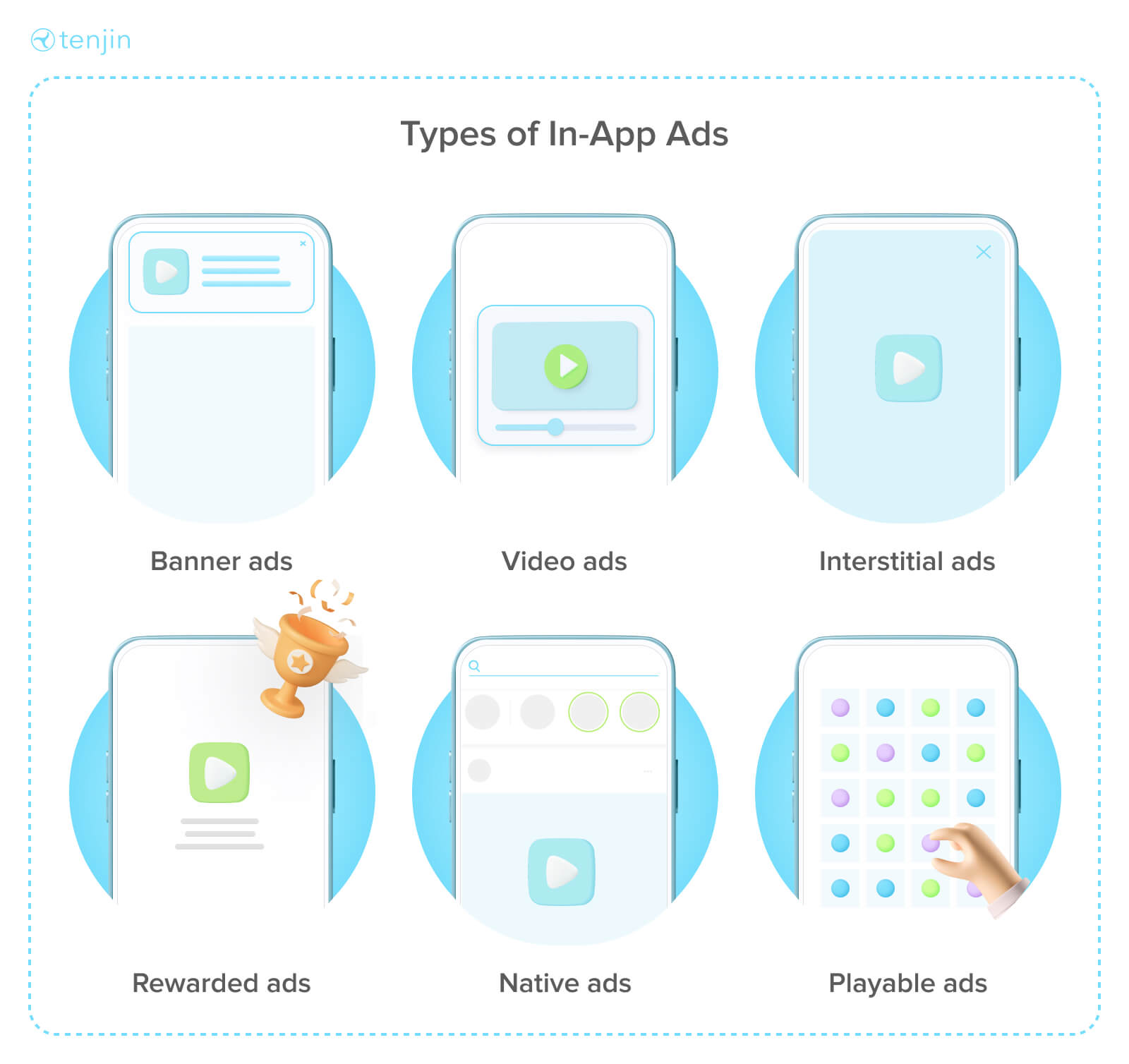
Choosing the right ad format is one of the most important decisions in an IAA strategy. Different formats work better in different contexts, and the wrong choice can hurt retention as much as it helps revenue.
Banner ads appear at the top or bottom of the screen and remain visible while the user interacts with the app. They are unobtrusive and work well in utility or productivity apps where interrupting the user experience would create friction.
Interstitial ads are full-screen ads that appear at natural transition points in the app, such as between screens or levels. They have high visibility but need to be timed carefully to avoid disrupting the user experience.
Rewarded ads give users something in return for voluntarily watching an ad. This opt-in format tends to generate strong engagement and is popular in apps where users are motivated by in-app rewards or benefits.
Video ads are short video clips that play within the app. They can be skippable or non-skippable and are common in streaming and content apps.
Native ads are designed to match the look and feel of the surrounding content, making them less disruptive and often more effective at driving engagement.
Playable ads are interactive mini-experiences that let users try a feature or gameplay loop before engaging further. They are particularly effective in apps where demonstrating the experience is a strong conversion driver.
How to Implement In-App Advertising
Getting IAA up and running involves a few key steps.
Map Your User Journey
Before placing any ads, identify the natural moments in your app where advertising fits without creating friction. Where does the user pause? Where do transitions happen? These are your ad opportunities.
Choose A Mediation Provider
An ad mediation platform connects your app with multiple ad networks simultaneously, running auctions to find the highest-paying ad for each impression. This maximizes your fill rate and revenue without requiring you to manage individual network relationships manually.
Select Your Ad Formats
Based on your app type and user behavior, decide which formats to use and where. Think about what will feel natural to your users rather than what is most intrusive.
Set Your Parameters
Work with your mediation provider to configure bids based on geography, placement, user segment, and other relevant factors. The more precisely you define your inventory, the more competitive the bids you attract.
Balance Ad Frequency With Retention
This is the most important ongoing consideration in IAA. Users who are shown too many ads in a short period will churn. Finding the right frequency for your specific audience is an ongoing process of measurement and adjustment, not a one-time decision.
Why Ad Frequency Matters
Revenue and retention exist in tension in an IAA model. More ads typically means more revenue per session, but also more friction and higher churn. Fewer ads means a better user experience, but potentially lower short-term revenue.
The goal is to find the frequency that maximizes long-term revenue per user, not just revenue per session. A user who churns after two sessions because of ad overload generates far less total revenue than a user who stays engaged for months at a moderate ad frequency.
Tracking metrics like ARPDAU alongside retention and LTV data gives you the visibility to find and maintain that balance.
Measuring IAA Performance with Tenjin
Tenjin connects your in-app advertising revenue data with your attribution and UA data, giving you a complete view of how IAA is contributing to your overall monetization performance.
With impression-level revenue data (ILRD) support, Tenjin can attribute ad revenue down to the individual user level, feeding more accurate LTV calculations and enabling ROAS-focused UA campaigns that optimize toward users likely to generate strong ad revenue over time.
Whether you are running a pure IAA model or a hybrid setup combining ads and in-app purchases, Tenjin gives you the data to measure performance, spot imbalances, and make informed decisions about where to optimize.
Related Terms
- In-App Purchases (IAP)
- Impression-Level Revenue Data (ILRD)
- Mobile App Monetization
- Ad Network
- Ad Revenue Attribution
- Average Revenue Per Daily Active User (ARPDAU)
- Effective Cost Per Mille (eCPM)
- Return On Ad Spend (ROAS)
- Lifetime Value (LTV)
- Mobile Measurement Partner (MMP)