Definition:
LTV, or lifetime value, is the total revenue generated by a user either over their entire time in an app, or within a defined time period. It is one of the most important metrics in mobile marketing, used to evaluate user quality, guide acquisition strategy, and measure the long-term health of an app.
LTV Formula (IAP):
IAP Revenue / Number of Users on Day 0
LTV Formula (Ad Revenue):
N-Day Ad Revenue / Number of Users on Day 0
LTV Formula (Total / Hybrid):
(N-Day IAP Revenue + N-Day Ad Revenue) / Number of Users on Day 0
What is LTV?
In mobile marketing, LTV meaning goes beyond a single number. It's a window into how much value your users are actually generating and how that value accumulates over time.
Every user you acquire has a cost. LTV tells you whether that cost is justified. If your LTV exceeds your cost per install (CPI) or customer acquisition cost (CAC), your campaigns are generating positive returns. If it doesn't, something needs to change, whether that's your targeting, your product experience, or your monetization model.
LTV is most useful when measured at the cohort level, grouping users by install date, acquisition source, or campaign, and tracking their revenue over time. This gives you a comparable, structured view of user quality across channels and periods.
Why LTV Matters in Mobile Marketing
LTV in marketing is a north star metric. It connects acquisition spend to real business outcomes and helps answer the questions that matter most:
- Are the users I'm acquiring actually worth what I'm paying for them?
- Which channels deliver the highest quality users over time?
- How should I adjust my CPI targets to stay profitable?
- Is my monetization model working for my audience?
Without LTV, you're optimizing for volume. With it, you're optimizing for value and that's a fundamentally more sustainable growth strategy.
LTV vs. CAC: What's the Difference?
CAC (customer acquisition cost) is what you spend to acquire a user. LTV is what that user generates in return. The relationship between the two is one of the most important ratios in mobile marketing.
| Metric | What It Measures |
| CAC | Total cost to acquire one user |
| LTV | Total revenue generated by one user |
| LTV:CAC Ratio | Return on every dollar spent on acquisition |
A healthy LTV:CAC ratio means your acquisition spend is generating sustainable returns. A ratio below 1:1 means you're spending more to acquire users than they're worth and that’s a signal that something in your funnel needs attention.
How to Calculate LTV
Calculating LTV depends on how your app is monetized. Tenjin tracks three core LTV variations, each built for a different monetization model:
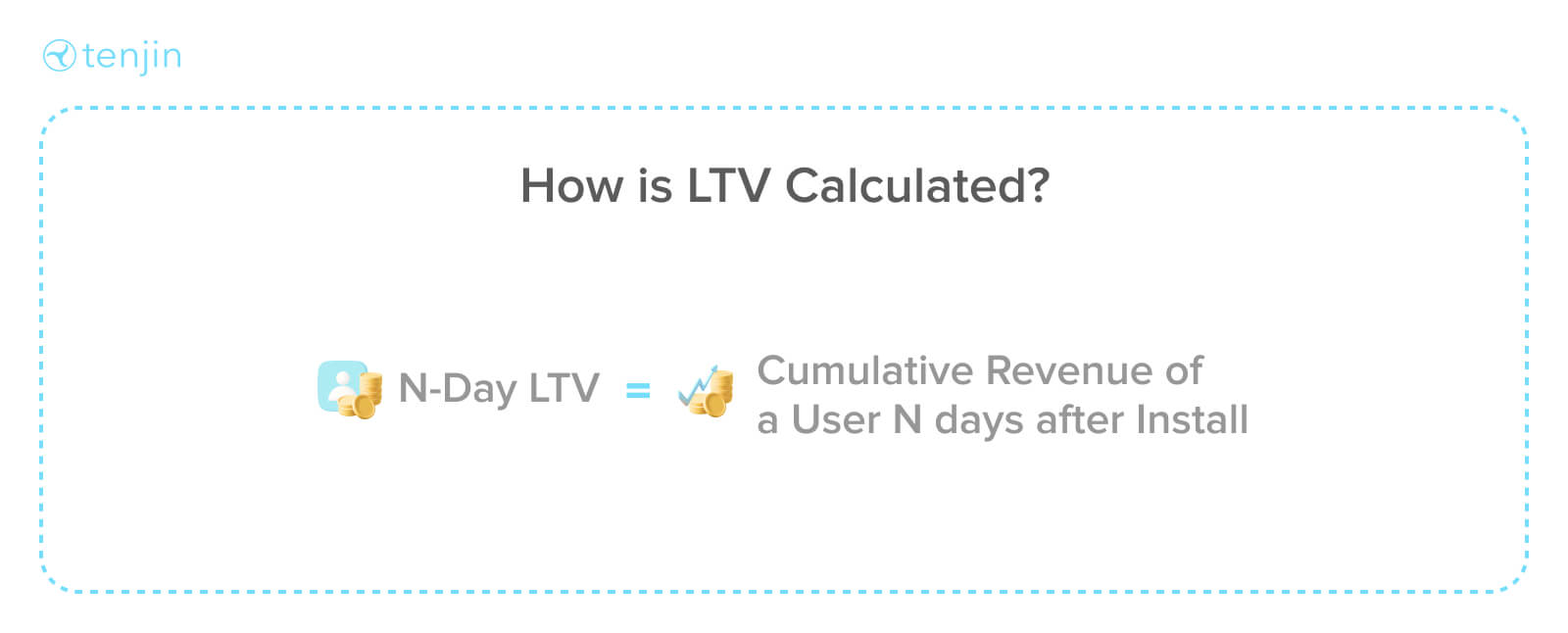
N-Day IAP LTV (In-App Purchase Lifetime Value)
For apps monetized through in-app purchases (IAP) or subscriptions. This is the cumulative IAP revenue generated N days after install.
Per user formula:
IAP Revenue / Number of Users on Day 0
N-Day Ad LTV (Ad Revenue Lifetime Value)
For apps monetized through In-App Advertising (IAA). This is the cumulative estimated ad revenue generated N days after install.
Per user formula:
N-Day Ad Revenue / Number of Users on Day 0
N-Day All LTV (Total Lifetime Value)
For apps using a hybrid monetization model combining in-app purchases and advertising. This is the cumulative total revenue from both streams N days after install.
Per user formula:
(N-Day IAP Revenue + N-Day Ad Revenue) / Number of Users on Day 0
LTV Cohorts: Measuring Value Over Time
LTV is most powerful when tracked across time cohorts. Rather than looking at a single snapshot, cohort-based LTV shows you how user value builds and where it plateaus.
Tenjin provides LTV cohort data across the following time periods:
| Cohort | Cohort | Cohort |
| 0-Day | 7-Day | 60-Day |
| 1-Day | 14-Day | 90-Day |
| 2-Day | 30-Day | 120-Day |
| 3-Day | 150-Day | |
| 4-Day | 180-Day | |
| 5-Day | 365-Day | |
| 6-Day |
One of the most commonly referenced benchmarks is the 7-Day IAP LTV, a strong early signal of long-term user value that many marketers use to guide acquisition decisions before longer cohorts mature.
Need a cohort that isn't listed here? Tenjin supports custom cohort metrics for teams that need to go deeper. Reach out to the team at support@tenjin.com to get started.
How to Increase LTV
Improving user lifetime value is a product and marketing challenge in equal measure. A few approaches that consistently move the needle:
- Improve onboarding: Users who understand your app early are more likely to stick around and spend
- Optimize your monetization model: Make sure your IAP pricing, ad placements, and reward structures align with how your users actually behave
- Focus on retention: Every additional day a user stays in your app is another opportunity to generate revenue
- Segment and personalize: High-LTV user segments often have distinct behaviors. Identify them early and tailor their experience accordingly
- Use predictive LTV: Don't wait 90 days to know if a cohort is valuable. Tenjin's pLTV modeling gives you a forward-looking view of user value so you can act faster
LTV and Predictive Modeling at Tenjin
One of the biggest challenges with LTV is that it takes time to mature. A 180-day LTV cohort tells you a lot, but waiting six months to make acquisition decisions isn't practical.
Tenjin's predictive LTV (pLTV) modeling addresses this directly. By analyzing early behavioral signals, Tenjin can project the long-term value of a user cohort with over 90% accuracy giving you actionable data far earlier in the campaign lifecycle.
That means smarter bidding, faster optimization, and acquisition decisions you can make with confidence.
Related Terms
- In-App Purchases (IAP)
- In-App Advertising (IAA)
- Cohort Analysis
- DataVault
- Mobile App Monetization
- Predictive Analysis
- Total Revenue
- Ad Monetization
- Return On Ad Spend (ROAS)