Definition:
Cost per mille (CPM) is the cost an advertiser pays for one thousand impressions of their ad.
The word mille is Latin for thousand, making CPM a literal translation of cost per thousand.
It is one of the most fundamental pricing models in mobile advertising and a metric that matters equally to publishers earning ad revenue and advertisers managing campaign spend.
Formula Snippet:
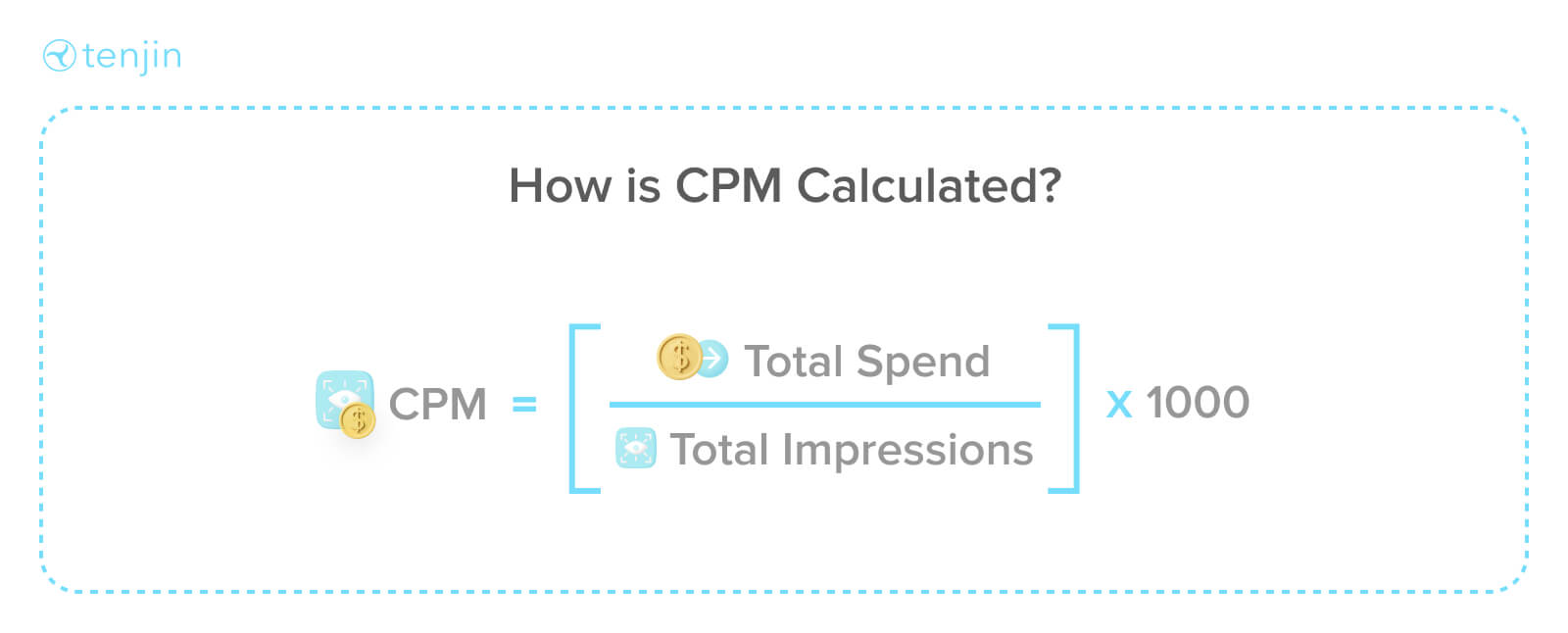
CPM = (Total Ad Spend / Total Impressions) × 1,000
For Mobile Publishers:
CPM determines how much revenue each thousand impressions generates. A higher CPM means more revenue from the same volume of traffic.
What is Cost Per Mille (CPM)?
Cost per mille is the standard unit of measurement for ad pricing based on impressions.
An impression is counted each time an ad is displayed to a user, regardless of whether that user clicks on it or takes any further action.
CPM defines how much that display costs the advertiser, or equivalently, how much it earns the publisher, for every thousand times it occurs.
CPM is used across virtually every channel in digital and mobile advertising. It is the pricing model behind programmatic display, in-app advertising, video campaigns, and many other formats. Understanding CPM is foundational to understanding how mobile advertising is bought, sold, and evaluated.
For advertisers, CPM is a measure of reach efficiency. It tells you how much you are paying to put your ad in front of one thousand people. For publishers, the equivalent metric is eCPM (effective cost per mille), which measures how much revenue is generated per thousand impressions across all demand sources, regardless of the underlying pricing model of each campaign.
CPM is a metric that sits between the intersection of two important questions in mobile advertising:
- For advertisers, the question is how efficiently am I reaching my audience.
- For publishers, the question is how much is my inventory worth. CPM is the metric that answers both.
例如 An advertiser runs a brand awareness campaign with a CPM of $8. For every thousand users who see the ad, the advertiser pays $8. If the campaign delivers 2,000,000 impressions, the total spend is $16,000. The publisher serving those impressions earns revenue based on the same calculation, minus the margin taken by the ad network.
What is Cost Per Impression?
Cost per impression is the per-unit version of CPM. Where CPM measures the cost per thousand impressions, cost per impression measures the cost of a single ad display. The two terms are directly related and are often used interchangeably in context, though CPM is by far the more common unit in practice because individual impression costs are typically fractions of a cent and are easier to communicate and compare at the thousand-impression scale.
Formula:
Cost Per Impression = CPM / 1,000
So if your CPM is $5, your cost per impression is $0.005. Working at the CPM level rather than the per-impression level makes the numbers more readable and more useful for planning and optimization purposes.
Understanding the relationship between cost per impression and CPM is particularly useful when evaluating the efficiency of different ad formats and placements. A rewarded video placement might carry a significantly higher CPM than a banner placement, but if it also delivers stronger engagement and 转化, the higher cost per impression can be well justified.
How to Calculate CPM
Knowing how to calculate CPM accurately is essential for both advertisers evaluating campaign efficiency and publishers benchmarking their ad revenue performance. The calculation itself is straightforward, but applying it correctly across different contexts requires understanding about what inputs to use and how to interpret the outcomes.
The CPM Formula:
CPM = (Total Ad Spend / Total Impressions) × 1,000

How to CPM: A Step-by-Step Calculation Guide
Step 1: Identify your total ad spend
This is the total amount spent on a campaign or ad placement over the period you are measuring. For advertisers this is your actual spend. For publishers calculating eCPM this is your total ad revenue.
Step 2: Identify your total impressions
This is the total number of times your ad was displayed over the same period. Ensure you are using the same time frame for both spend and impressions to avoid skewing the result.
Step 3: Divide spend by impressions
Divide your total spend by your total impressions to get the cost per individual impression.
Step 4: Multiply by 1,000
Multiply the result by 1,000 to convert to the per-mille unit. This gives you your CPM.
例如
- Total ad spend: $5,000
- Total impressions: 1,250,000
- CPM = ($5,000 / 1,250,000) × 1,000
- CPM = $0.004 × 1,000
- CPM = $4.00
How to Calculate CPM in Reverse
You can also use the CPM formula to calculate total spend or total impressions when you know the other two variables. This is particularly useful if you are in the planning phase.
To calculate total spend from CPM and impressions:
Total Spend = (CPM × Impressions) / 1,000
To calculate impressions from CPM and spend:
Impressions = (Total Spend / CPM) × 1,000
These reverse calculations are particularly useful for campaign planning. If you have a fixed budget and a target CPM, you can calculate exactly how many impressions your budget will buy. If you have an impression goal and a benchmark CPM, you can calculate the budget required to hit it.
例如 An advertiser has a budget of $10,000 and expects an average CPM of $6.50 based on historical data. Using the reverse formula, they calculate that their budget will deliver approximately 1,538,000 impressions. This gives them a realistic reach estimate before the campaign launches, allowing them to assess whether the budget is sufficient for their awareness goals.
eCPM vs. CPM: What is the Difference?
CPM and 什么是移动营销里的eCPM,以及如何计算? are closely related but serve different purposes and are used from different perspectives.
CPM is the rate agreed upon or observed for a specific campaign or placement. It is the price an advertiser pays for one thousand impressions under a CPM pricing model.
eCPM, or effective cost per mille, is a normalized metric that publishers use to compare revenue performance across ad placements, networks, and campaigns that may operate under different pricing models. It converts all revenue, whether earned under CPM, CPC, CPI, or any other model, into a common per-thousand-impression unit so that performance can be compared on an equal footing.
| CPM | 什么是移动营销里的eCPM,以及如何计算? | |
| What it measures | Cost of 1,000 impressions to the advertiser | Revenue earned per 1,000 impressions by the publisher |
| Who uses it | Advertisers | Publishers |
| Pricing model | Specific to CPM-priced campaigns | Normalized across all pricing models |
| Purpose | Campaign cost planning and evaluation | Ad revenue benchmarking and optimization |
| Formula | (Spend / Impressions) × 1,000 | (Revenue / Impressions) × 1,000 |
For publishers, eCPM is the more actionable metric because it allows you to compare the revenue efficiency of every placement and network in your stack regardless of how each one prices its inventory. A network paying on a CPI model and a network paying on a CPM model can be directly compared using eCPM as the common unit.
What is Average CPM in Mobile Advertising?
Average CPM in mobile advertising varies significantly depending on platform, geography, ad format, app category, and time of year. There is no single universal benchmark, and averages can be misleading without the right context.
- iOS consistently delivers higher average CPMs than Android in Tier 1 markets like the United States, United Kingdom, Australia, and Japan, driven by stronger advertiser demand and higher user purchasing power.
- Geography is one of the strongest determinants of CPM overall, with Tier 1 markets commanding significantly higher rates than Tier 2 and Tier 3 markets.
- Q4 consistently delivers the highest CPMs of the year due to holiday advertiser demand, while Q1 typically sees a notable dip as budgets reset.
- Ad format is the other major variable. As a general rule, higher-engagement formats command higher CPMs because they deliver more value to advertisers.
- Rewarded video: highest CPMs of any mobile format due to user-initiated, high-completion viewing
- 试玩广告: premium CPMs driven by strong engagement and intent signals
- Interstitial ads 插播广告: mid-range CPMs, consistent performers across most app categories
- 原生广告: variable CPMs depending on placement quality and audience fit
- 横幅广告: lowest CPMs due to lower engagement rates and banner blindness
For up-to-date CPM benchmarks by network, format, and market, Tenjin publishes regular benchmark reports.
What Affects Your CPM?
CPM is not fixed. It fluctuates based on a range of factors that both advertisers and publishers can influence through strategic decisions.
For Advertisers
Audience targeting: More precisely targeted audiences typically cost more per impression because they are more valuable to the advertiser. Broad targeting delivers lower CPMs but less relevant reach.
Ad format: As covered above, format significantly influences CPM. Higher-engagement formats command premium prices.
Competition: CPMs in programmatic environments are determined by auction dynamics. More advertisers competing for the same inventory drives prices up. Category seasonality and campaign timing both affect how competitive the auction environment is at any given moment.
Creative quality: Ad networks increasingly factor engagement signals into how they price and prioritize inventory. High-performing creatives that drive strong completion rates and positive user signals can improve the effective value you get from a given CPM.
For Publishers
Audience quality: Publishers with highly engaged, high-value audiences attract stronger advertiser demand and command higher CPMs. Audience quality is built through strong onboarding, retention, and engagement, making product quality a direct input into ad revenue.
Ad placement and format mix: The placements and formats you offer directly determine your CPM ceiling. A publisher offering only banner inventory will always have lower average CPMs than one offering a mix of rewarded video, interstitials, and native placements.
Geographic mix of users: If the majority of your users are in low-CPM markets, your average eCPM will reflect that regardless of how well you optimize everything else. Growing your user base in high-CPM markets is one of the most impactful things a publisher can do to improve overall ad revenue.
Number of demand sources: Publishers who use ad mediation to run multiple ad networks in competition for their inventory consistently achieve higher CPMs than those relying on a single network. Competition drives prices up.
How to Measure and Optimize CPM with Tenjin
Understanding your CPM and eCPM data across multiple networks, markets, and formats is one of the most operationally complex challenges in mobile publishing. Each ad network has its own dashboard and its own reporting format. Without a unified view, comparing true performance across your entire ad stack is almost impossible.
As a mobile measurement partner (MMP), Tenjin is a mobile marketing analytics toolkit that aggregates all your ad revenue data in a single dashboard, giving you a clear and accurate view of your eCPM performance across every network, market, format, and user cohort without manual handstitching.
With Tenjin you can:
- Track eCPM across all ad networks in one place without switching between dashboards
- Compare CPM and eCPM performance by geography, ad format, and network side by side
- Identify which networks are delivering the strongest CPMs in your key markets
- Combine ad revenue and IAP data for a complete ARPDAU view that accounts for all monetization
- Analyze eCPM trends over time to anticipate seasonal fluctuations and plan accordingly
- Export raw impression and revenue data through DataVault for deeper custom analysis
Knowing how to calculate CPM is only the start. Real value comes from having the infrastructure to measure continuously, so you can compare across your full network stack. This overview allows for a holistic perspective, so you can act on the insights it surfaces.
Common CPM Mistakes
These are the most common mistakes publishers and advertisers make when working with CPM data.
1. Benchmarking Against Global Averages
Average CPM figures published without geographic context are rarely useful. A global average that blends Tier 1 and Tier 3 market performance tells you very little about whether your specific CPMs are competitive. Always benchmark against averages that match your platform, market, and ad format.
2. Optimizing CPM in Isolation
A high CPM is not always better if it comes at the cost of fill rate. A network delivering a $12 CPM but only filling 60% of your inventory may generate less total revenue than a network delivering an $8 CPM with a 95% fill rate. Always evaluate CPM alongside fill rate and total revenue generated.
3. Ignoring Seasonality
CPM fluctuations across the calendar year are predictable and significant. Publishers who do not account for Q4 peaks and Q1 troughs in their revenue planning will consistently be caught off guard by changes that are entirely normal and foreseeable.
4. Relying on a Single Ad Network
A single ad network means a single demand source, which means no competition for your inventory and no floor on the CPMs you receive. Ad mediation introduces competition and consistently delivers higher eCPMs than any single network alone.
5. Measuring CPM Without Connecting It to User Value
CPM tells you what your impressions are worth to advertisers. It does not tell you what your users are worth to your business. Publishers who optimize purely for CPM without connecting ad revenue data to user LTV, retention, and overall ARPDAU risk optimizing for a metric that does not reflect their true revenue picture.
主要结论
Cost per mille is a foundational metric in mobile advertising that every publisher and advertiser needs to understand, calculate accurately, and monitor continuously.
- CPM measures the cost of one thousand ad impressions and is the standard unit for pricing and evaluating ad inventory
- The CPM formula is: (Total Spend / Total Impressions) × 1,000
- eCPM is the publisher-side equivalent, normalizing revenue across all pricing models into a common per-thousand-impression unit
- Average CPM varies significantly by platform, ad format, geography, and time of year. There is no single universal benchmark
- iOS delivers higher average CPMs than Android in Tier 1 markets. Rewarded video commands higher CPMs than any other mobile ad format
- Q4 consistently delivers the highest CPMs of the year driven by holiday advertiser demand. Q1 typically sees a meaningful dip
- CPM should always be evaluated alongside fill rate and total revenue, not in isolation
- Ad mediation increases CPMs by introducing competition for your inventory across multiple demand sources
- Tenjin gives publishers a unified view of eCPM performance across all networks, markets, and formats without manual reconciliation
Related Terms
- 什么是移动营销里的eCPM,以及如何计算?
- 广告变现/收入归因
- ARPDAU
- In-App Advertising (IAA 应用内广告)
- 广告渠道(Ad Network)
- Ad Monetization(广告变现)
- CPI (Cost Per Install)
- CPC (Cost Per Click)
- 有奖广告
- Programmatic Buying/Advertising
- Mobile Measurement Partner (MMP)
- DAU
常见问题解答
What is cost per mille (CPM)?
Cost per mille (CPM) is the cost an advertiser pays for one thousand impressions of their ad. It is one of the most widely used pricing models in mobile advertising and a core metric for both publishers measuring ad revenue and advertisers managing campaign spend.
How do you calculate CPM?
CPM is calculated using the formula: CPM = (Total Ad Spend / Total Impressions) × 1,000. Divide your total spend by your total impressions to get the cost per individual impression, then multiply by 1,000 to convert to the per-mille unit.
What is cost per impression?
Cost per impression is the per-unit version of CPM. It measures the cost of a single ad display rather than one thousand. The formula is: Cost Per Impression = CPM / 1,000. If your CPM is $5, your cost per impression is $0.005.
What is the difference between CPM and eCPM?
CPM is the rate an advertiser pays for one thousand impressions under a CPM pricing model. eCPM normalizes revenue across all pricing models into a common per-thousand-impression unit, allowing publishers to compare performance across networks and placements regardless of how each one prices its inventory.
What is average CPM in mobile advertising?
Average CPM varies significantly by platform, ad format, geography, and time of year. iOS typically delivers higher CPMs than Android in Tier 1 markets. Rewarded video commands the highest CPMs of any mobile ad format while banner ads typically deliver the lowest. Q4 consistently delivers the highest CPMs of the year due to holiday advertiser demand.
What factors affect CPM in mobile advertising?
CPM is affected by audience quality, ad format, geographic mix of users, number of demand sources, advertiser competition, creative performance, and time of year. Publishers can improve their eCPMs by using ad mediation, offering high-engagement formats like rewarded video, and growing their user base in high-CPM markets.
How do I use CPM to plan my advertising budget?
Use the CPM formula in reverse to plan budgets. To calculate total spend: Total Spend = (CPM × Impressions) / 1,000. To calculate impressions from a budget: Impressions = (Total Spend / CPM) × 1,000. These calculations give you realistic reach estimates before a campaign launches.