Re-engagement Attribution measures your retargeting campaigns. When a lapsed user comes back to your app after engaging with one of your paid ads, Tenjin credits that campaign for the return.
How it works #
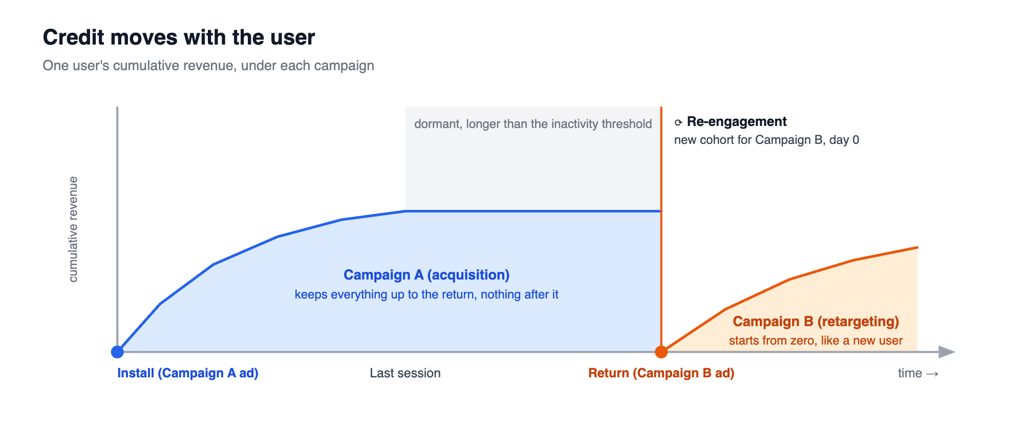
Credit for a returning user moves to the retargeting campaign that brought them back.
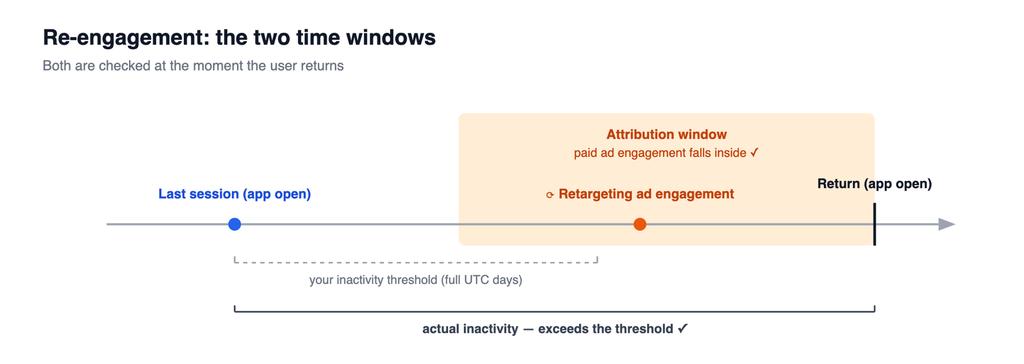
- A return qualifies when the user was inactive longer than your inactivity threshold (default 7 days) and engaged with a paid ad within your Attribution Window, on a channel where Re-engagement is enabled.
- Two kinds of return are attributed
- Reinstall: the user deleted the app, then installed it again
- Reactivation (re-open): the user kept the app and came back
- The return is credited to the retargeting campaign and counted as a Tracked Re-engagement;
- a reinstall is also counted as a Tracked Reinstall.
- Cohort metrics for that user (retention, revenue, ROAS) start again from the day of the return.
- Tenjin sends the channel a Re-engagement callback.
iOS reinstalls need user opt-in (presence of IDFA). Without it a reinstall can’t be recognized as the same device and is counted as a new Install. iOS reactivations are not affected and work the same as on Android.
Supported channels #
Re-engagement is available on a growing list of channels. Contact Tenjin Customer Support to confirm the channels you plan to run retargeting on.
Reporting Metrics #
- Tracked Re-engagements
- Returns credited to a paid campaign, where the user reinstalled and reactivated (re-opened the app).
- Unqualified or organic returns are not counted.
- Tracked Reinstalls
- Reinstalls that result in a new Attribution: credited to a paid campaign, or organic when the user’s previous Attribution can’t be restored.
- When a reinstall doesn’t qualify for Re-engagement (the user wasn’t inactive long enough, or no eligible paid ad engagement is found), the user’s previous Attribution is resumed by default. Such a reinstall is not counted.
- A paid reinstall is also counted in Tracked Re-engagements.
Impact on Your Acquisition Campaigns #
- The original acquisition campaign keeps its Install and everything the user did before the return. From the return onward, the user’s sessions and revenue count under the retargeting campaign instead, so the acquisition campaign’s LTV and ROAS stop growing for that user.
- Cohort metrics for the retargeting campaign (retention, revenue, ROAS) count from the day of the return, not from the original Install.
- A longer inactivity threshold re-attributes fewer users and moves less credit.