

塔拉-迈耶
Adding ads to a subscription app, or subscriptions to an ad-supported one, seems like it could be an easy route to more revenue. In reality, a second revenue stream only pays off when it creates new value, rather than quietly shifting revenue from one model to another. The real challenge is increasing profitability without sacrificing user retention.
在新一期Tenjin的 ROI 101, “Mobile App Trends 2026: Downloads & Revenue by Category and Country,” Roman Garber, Marketing Director of Tenjin sat down with Google’s Mariusz Gąsiewski to examine the rising relevance of subscriptions, how ad acceptance varies across markets, and the advantages and disadvantages of 混合变现. Their guidance suggests building around real user behavior, then measuring whether the combination creates incremental value.
您将了解
- Hybrid monetization should grow revenue, not reshuffle it.
Measure the whole outcome, not the newest line item. - Start with user behavior, not revenue formats.
The right model depends on what users value and when. - Non-purchasers can still be valuable.
Some users matter to advertisers even if they never buy in-app. - Engagement is not tolerance.
Frequency, relevance, and control are part of the model. - Test it like a product change.
Define the audience, the guardrails, and success before launch. - Align monetization and acquisition.
Both teams need one shared definition of a valuable user.
What is Hybrid Monetization?
Hybrid monetization combines two or more revenue models within one app business. Common pairings include:
- A paid subscription alongside an ad-supported free tier
- Advertising plus one-time 应用内购买
- Subscriptions, advertising, and one-time purchases together
- A free product that serves ads to some users and offers upgrades to those who want more access or fewer interruptions
The right monetization model depends on the product. A content app might pair limited, ad-supported free access with a subscription for everything. A utility app might keep core features free and reserve advanced workflows for subscribers. A game might blend in-app purchases with 激励广告. In every case, users differ in their preferences and willingness to pay.
Define your terms precisely. Subscriptions are often purchased through in-app billing, but they shouldn’t be counted twice, once as 订阅收入 and again as in-app purchase revenue. Your team needs accurate reporting that can handle multiple revenue streams before it can judge whether a hybrid model is working.
The Case for Hybrid Monetization Models
A hybrid business model gives your app more ways to serve its audience. For example, some users will pay for an uninterrupted experience, but others would rather give their time to ads than their money to a subscription. Some will never pay in either sense, yet still contribute by engaging, leaving reviews, giving referrals, or contributing to organic discovery.
Roman sums up the opportunity:
“There are still a lot of opportunities for combining subscriptions with IAA.”
(IAA stands for 应用内广告.) This isn’t a mandate for every subscription app to add ads. It’s a prompt to ask whether your current model leaves a valuable audience without a good option.
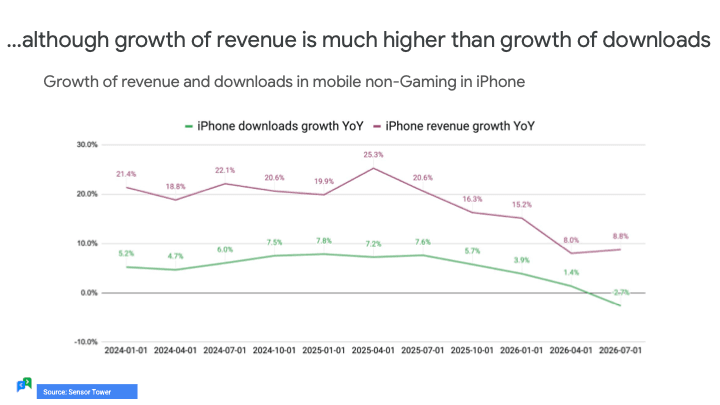
The latest data points to a meaningful shift for iOS app teams. In the iPhone non-gaming series, a July 2026 data point shows store revenue up 8.8% year over year, while downloads declined 2.7%. Revenue is growing even as fewer new users arrive.
One data point doesn’t define a market, but it does sharpen a useful question for growth teams: how much value are you creating from the users you already have? When new-user growth slows, retention, engagement, and pricing become more important levers, alongside acquisition rather than instead of it.
In practice, that means paying closer attention to customer 终身价值LTV, testing subscription pricing and tiers, and understanding what keeps users engaged over time.
It’s also worth being clear about what this data doesn’t show. The report covers store-billed subscriptions and 应用内购买 only, so it doesn’t capture advertising revenue. For many apps, ads remain an important part of total value. The most complete picture comes from measuring subscriptions, purchases, and ad revenue side by side, at the user or 队列层面.
Deliver Meaningful Outcomes
A strong hybrid business model begins with understanding user behavior rather than with a revenue format. Do the market research and ask what people are trying to accomplish in your app, how often they return, and what they value enough to pay for. Then consider how an ad would feel in that exact moment, some call it the “Boring Test.” An ad before casual content may be perfectly acceptable. An interruption during a sensitive health workflow can erode trust.
Mariusz suggests that subscription behavior matures as people grow accustomed to paying for streaming and other digital services. However, keep in mind that this is his interpretation and not a universal rule for every country or product. At the same time, the trending normalization of subscription products provides an interesting and valuable research prompt: do your users recognize the worth of an ongoing paid relationship with your app?
Geography, location, and tier belong in that research area too. Mariusz states that advertising may be more readily accepted in some emerging markets than in top Tier 1 markets. Either way, testing for local expectations around price, payment, content, and ad frequency should be carried out whenever possible. It’s more precise than applying a blanket label to an entire country. Our guide to researching your app’s target market explains how to compare these variables before deciding where to grow.
Moving Revenue Around Isn’t the Same as Growing It
A rise in 广告收入 can mislead if it comes from users who would otherwise have subscribed, purchased, or stayed longer. Likewise, a jump in new subscription revenue isn’t healthy if the product becomes less useful for people who can’t or won’t pay.
Mariusz’s warning deserves attention:
“Too often, even hybrid monetization is just moving extra dollars from one pocket to another.”
In practice, this can happen when teams optimize each revenue stream in isolation. The advertising team celebrates more impressions. The subscription team notes a shift in conversion. Neither view captures the full, user-level outcome.
So don’t stop at “Did ad revenue increase?” Ask whether total revenue, retention, and long-term customer value improved for comparable users.
What Does Incremental Value Look Like?
| 指标 | 价值所在 | Warning Signs |
| Total revenue per assigned user | Combines subscription, purchase, and advertising value | Measuring only the new revenue stream |
| Subscription conversion and renewals | Shows whether ads affect the paid relationship | A short-term ad gain paired with weaker renewals |
| Retention and engagement | Indicates whether the experience remains useful | More impressions because users struggle to finish a task |
| User feedback and support volume | Surfaces experience damage early | Treating complaints as separate from monetization results |
| Net profitability | Accounts for serving, product, and acquisition costs | Declaring success on gross revenue alone |
These metrics won’t always move in unison. When read together, they reveal the trade-off your model creates and whether it genuinely serves the business.
The Blind Spot: Valuable Users Aren’t Always Purchasers
Not every valuable user is a paying one. For example, a user who will never hit the subscribe button can still matter a great deal to an advertiser, particularly when it comes to brand focused engagement. Mariusz illustrated this with a personal example:
“They are a very good audience for many brands, but they very rarely buy something in apps or games.”
It’s a single observation, but it exposes a common gap. If you measure user value by purchase power alone, you can also overlook the attention that brands are willing to pay for. With relevant, respectful ad experiences, those users become an additional source of revenue rather than a lost cause.
It still demonstrates why a purchase-only view of user value can be too narrow. A brand may prize the attention of users who will never buy in-app. When the ad experience is relevant and respectful, that attention becomes an incremental path to more revenue.
The reverse can happen too: low purchase propensity doesn’t license an app to saturate users with ads. Engagement is not the same as tolerance. Product design, frequency, relevance, and user control are all part of the monetization model.
How to Test Hybrid Monetization Models
It’s important to treat 混合变现 as a product and measurement experiment, not a one-way settings change.
Where feasible, compare eligible users on the existing experience with comparable users on the hybrid version. Decide who’s eligible, how long the test runs, and what a positive result looks like before you launch.
Test Checklist
1. Define the audience.
Don’t test every user by default. Pinpoint the segment whose experience you want to improve, such as non-subscribers who hit a content limit, or users with low purchase propensity.
2. Define the treatment.
Specify exactly what changes: a rewarded ad, a limited ad-supported tier, a subscription offer after a usage threshold, or something else.
3. Set guardrails.
Choose retention, renewal, complaint, and experience measures that must not deteriorate beyond an agreed threshold.
4. Measure total value.
Combine ads, subscriptions, and one-time purchases at the user or cohort level, with costs kept in view.
5. Choose the right observation window.
A result that looks promising on day seven can be reversed later by cancelled subscriptions or weaker retention.
6. Document the decision.
Expand, adjust, pause, or stop based on the full body of evidence, not one flattering dashboard metric.
A structured test is a reliable way to tell whether your hybrid monetization model is growing revenue or simply moving it from revenue type to another. It depends on having subscription, purchase, and ad revenue data accessible and side by side, at the user and cohort level. This is the type of dashboard view Tenjin is built for.
Connect Monetization to Acquisition Decisions
Acquisition teams need to work with a shared definition of what makes a user valuable. If you optimize toward a first purchase, you may overlook ad-supported value. If you optimize toward ad revenue, and you may acquire users who never form a lasting relationship with the product.
This is why monetization and user acquisition need to agree on a definition of user value. The definition might include observed subscription revenue, one-time purchases, advertising revenue, retention, and a clearly labelled forecast of longer-term value. Whatever the elements are, the data and results should guide which audiences, countries, and messages you test next.
Read our guide to evaluating acquisition beyond early ROAS for a practical framework. If you’re still deciding which users and markets your product is best placed to serve, start with app market research.
Hybrid Monetization is Ultimately a Fit-and-Test Decision
The best hybrid monetization model isn’t the one with the most revenue lines on a dashboard. It’s the one that creates more total value without weakening the reason people use your app.
We suggest starting with a specific audience to test and a specific product moment. Make one focused change. Measure the whole outcome. Then scale when the evidence shows that subscriptions, advertising, and user experience are working in concert.